
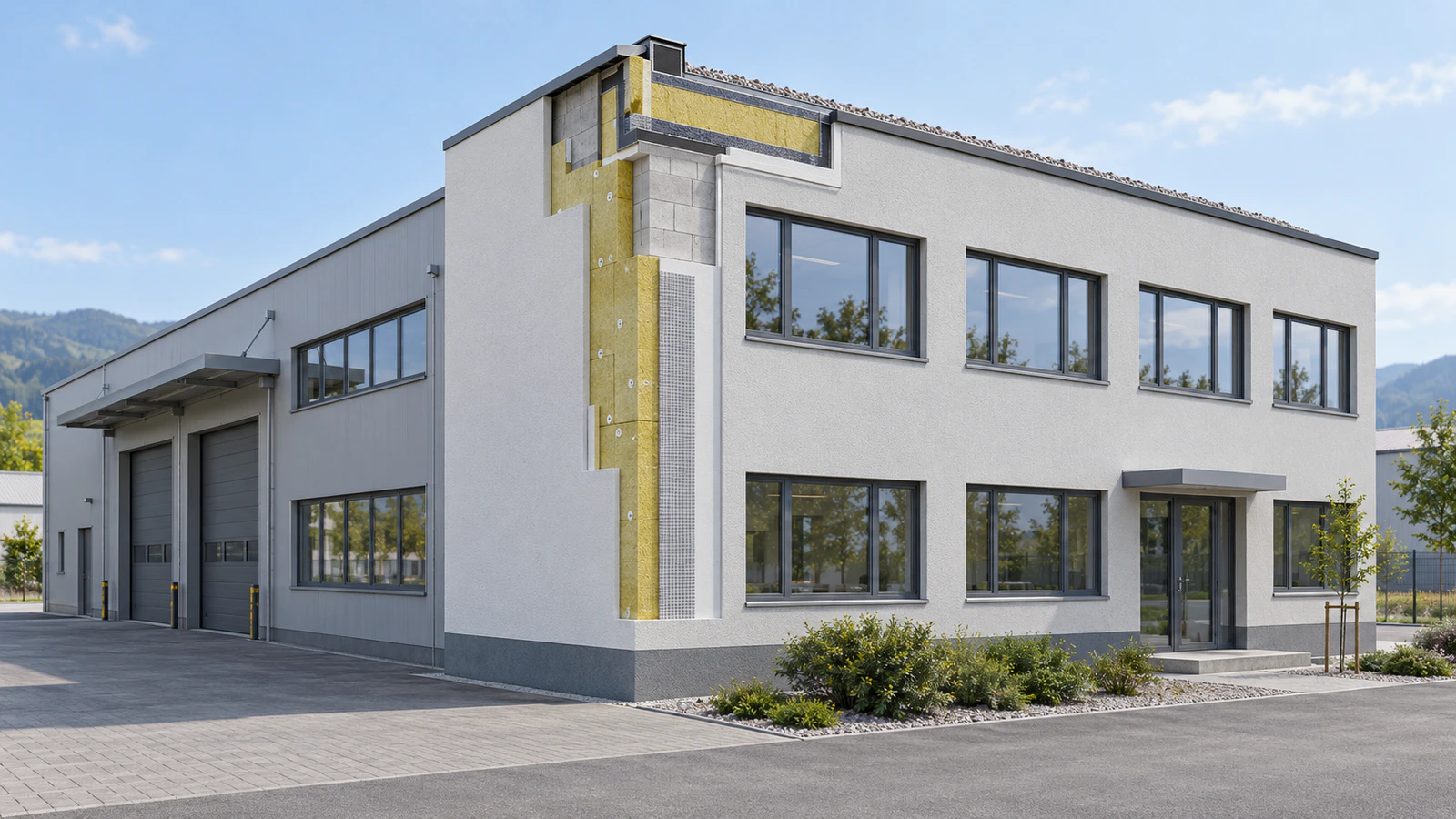
Illustration of the energy renovation of a business building.
Eko sklad 88KOH-PO26 offers businesses a loan for the energy renovation of older business buildings, with a starting fixed interest rate of 0.0% a year. Subject to the conditions, up to 40% of the approved principal may be written off. This can be a useful opportunity for a building owner, but eligibility, expected energy savings and the funding plan need to be checked before ordering any work.
When renovating a façade, roof or heating system, an attractive loan alone does not make a sound investment. What matters is the work undertaken, how the measures work together and how the final result will be demonstrated.
Status checked on 23 October 2026: the official website lists the call as open. It was published on 30 September 2026, and applications are accepted up to and including the day its closure is announced. Before applying, always check Eko sklad’s current public call 88KOH-PO26 and its annexes.
Key conditions of Eko sklad 88KOH-PO26
| Loan amount | EUR 100,000–5,000,000, covering no more than 85% of eligible costs. |
|---|---|
| Minimum eligible costs | EUR 117,650, generally excluding VAT; VAT is included where the applicant cannot deduct input VAT. |
| Remaining funding | At least 15% of eligible costs from own funds or other permitted sources outside this loan; funding for the entire investment must be secured. |
| Interest rate | Fixed at 0.0% a year, subject to exceptions involving other public support and state aid limits. |
| Repayment | 2–15 years, including the principal repayment moratorium; final maturity no later than 30 June 2045. The term is also limited by the investment’s payback period. |
| Principal write-off | Conditionally up to 40% of the approved loan, subject to state aid rules. |
| Energy performance | At least a 20% reduction in specific total primary energy demand compared with the situation before the investment. |
Eko sklad also assesses the applicant’s creditworthiness and the adequacy of collateral. There are no loan approval, administration or early repayment fees, but valuation, notarial, security-related and other third-party costs may arise. “0% interest” therefore does not mean that the entire process is free of charge.
Who is eligible for energy renovation under this call?
The call is intended for legal entities and natural persons carrying out an economic activity and entered in the Slovenian Business Register. Public institutions, municipalities and direct users of the state budget are excluded. Further restrictions apply to activities and state aid, so a company’s legal form alone does not establish eligibility.
Applicants must own the building in which they conduct their economic activity. Ownership is checked against the land register. Specific rules and proportionate recognition of costs apply to co-ownership and mixed-use cases.
The building’s age and lawful status must also be established. Among other conditions, the call requires a building permit or other appropriate legal acts relating to construction before 1 July 2010, and an occupancy permit issued before 1 January 2023. Buildings that were not heated before renovation and buildings intended for resale on the market are among those excluded.
This is not a general grant for apartment blocks. The call concerns the renovation of an older business building that is not intended for residential use. Condominium ownership and mixed use require a specific check of the call’s provisions. We cover PZI documentation for Eko sklad and apartment building renovation separately.
What work can business building renovation include?
Eligible measures improve the building envelope and technical systems. They include:
- thermal insulation of façades, walls in contact with the ground, floors, and floors above unheated basements or other unheated spaces;
- thermal insulation of flat or pitched roofs, or ceilings below unheated attics;
- replacement of external windows and doors, and ventilation with heat recovery;
- a heat pump, wood biomass boiler or connection to district heating, subject to the call’s conditions;
- replacement of lighting and optimisation of the heating system.
A solar power system for self-consumption, energy storage and charging infrastructure may be additional measures. They are not sufficient on their own: the same investment must include at least one eligible measure from groups A–J.
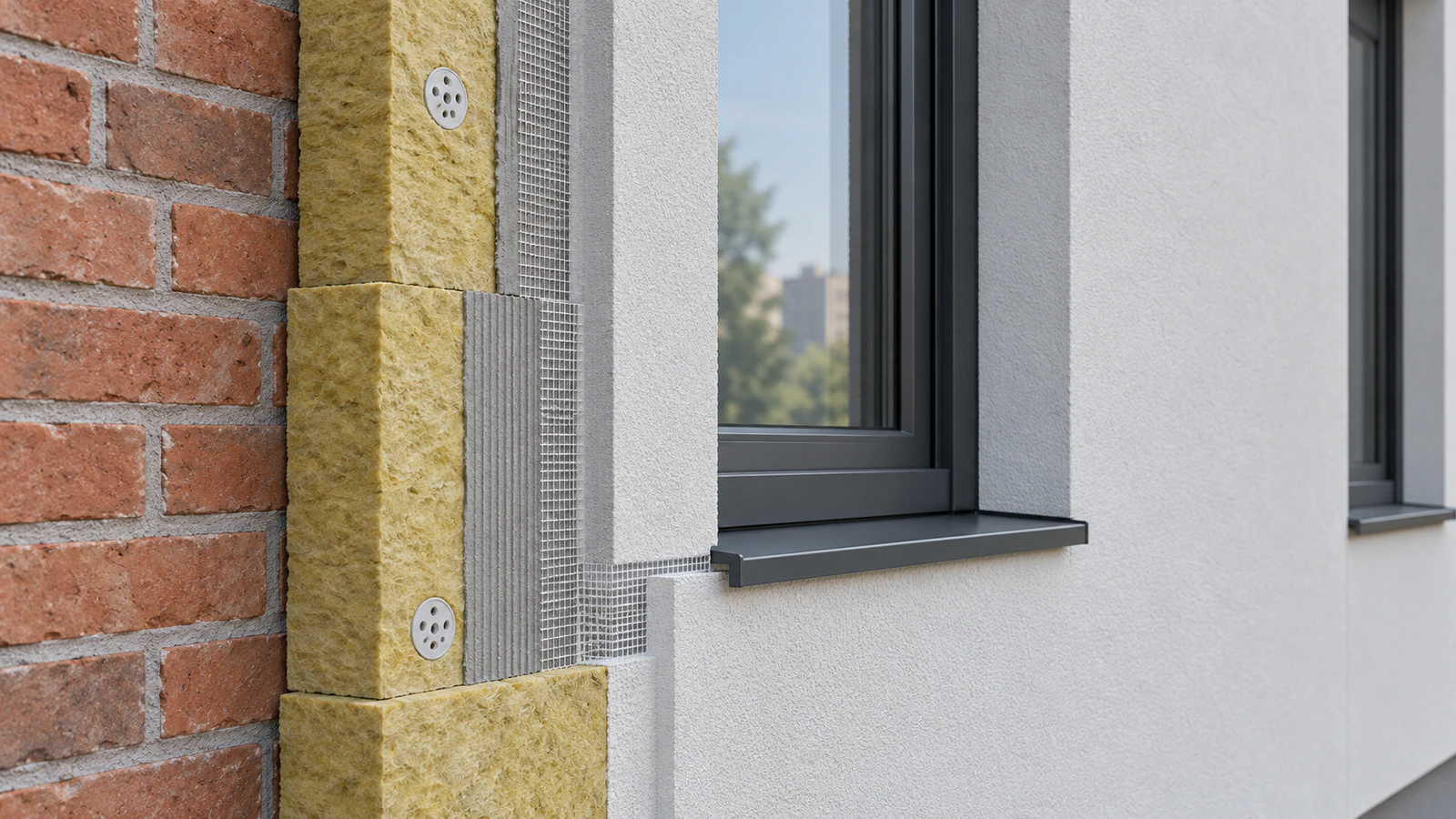
Each measure must meet Annex 2 – Technical requirements (PDF, in Slovenian). A quotation simply stating “new façade” or “new roof” is not enough. It must identify suitable materials, their properties, quantities and the scope of work. For roofs, distinguish insulation, the complete flat roof system and the roof covering: the covering is generally ineligible unless it forms part of a thermal insulation panel.
At least 20% savings: what must be demonstrated?
The requirement concerns specific total primary energy demand, rather than simply a lower electricity or heating bill. The existing and proposed conditions must be calculated using the same methodology and comparable assumptions.
The application requires a calculation-based energy performance certificate for the existing condition, the original calculation files, and a technical report and energy performance statement for the proposed condition. After completion, the actual as-built performance must also be demonstrated. Where a calculation-based certificate cannot be issued for the building, the call provides for an energy performance statement as a substitute.
The scope of work should therefore follow a building assessment and calculations. Thicker façade insulation alone does not establish that the investment will reach the required threshold. The roof, windows, thermal bridges, ventilation and existing systems also matter.
Why prepare PZI documentation and a bill of quantities before ordering?
For energy renovation, funding requirements must be reconciled with the building’s actual condition. On a façade, we check the substrate, existing build-up, plinth, window reveals, sills and roof junctions. Roof design also needs to address drainage, moisture, layer build-up and penetrations. A considered design resolves these interfaces before the contractor arrives.
Appropriate PZI construction documentation and a detailed bill of quantities help obtain comparable quotations and define what the price includes. The required documentation and permits depend on the type of intervention. During construction, construction supervision checks conformity with the design, installed materials and key details.
An important distinction: necessary documentation is not automatically an eligible cost. Section 7.4 expressly excludes design, permits, internal supervision and feasibility studies from eligible costs. Budget for these items separately.
Apply before starting the investment
Eko sklad 88KOH-PO26 supports new investments. “Starting” can mean more than construction work: the first legally binding equipment order or another irreversible commitment may already count. Under the call, design, obtaining permits and preparatory studies do not constitute the start of the investment. The investment must not be completed before the decision is issued.
Before applying, it is sensible to address the following:
- Ownership and permits: check the land register, use, age and lawful status of the building.
- Technical solution: select measures, prepare comparative energy calculations and define the documentation required.
- Quotations and evidence: collect itemised quotations, technical data and photographs of the existing condition.
- Funding: secure the remaining funds and check creditworthiness, collateral and public aid already received.
- Environmental conditions: check the DNSH principle, waste management and other requirements relevant to the investment.
Submit the application and supporting documents to vloge@ekosklad.si, or exceptionally in person or by post as specified in the call. Use the current official forms: an older saved version may omit required information.
Claim the write-off of up to 40% of principal on time
The partial write-off is not paid into the company’s account as freely available cash. It reduces the loan principal under an amendment to the loan agreement. The investment must be fully paid for, delivered and in use. The required energy performance, capitalisation of the full investment value as fixed assets and the start of depreciation must be demonstrated. An occupancy permit is also required where a building permit was mandatory.
The final report and write-off claim must be submitted no later than 30 days before the moratorium ends. The right to claim lapses after that deadline. Collect invoices, payment evidence and photographs of concealed layers as work progresses, rather than waiting until completion.
The standard completion period is nine months from the loan agreement. An extension of up to three months is possible only for substantiated objective reasons. The call’s absolute dates also apply, including 31 May 2029 for completing the investment. Support acknowledgement and document retention obligations continue after the works are finished.
40% of the loan is not 40% of the renovation cost
With eligible costs of EUR 200,000 and a loan approved at 85%, the loan would be EUR 170,000. A possible 40% write-off of that loan would be EUR 68,000, or 34% of eligible costs. This is only an illustration, not a prediction of approval: the decision, state aid rules and compliance with all conditions determine the actual share.
Eko sklad 88KOH-PO26: frequently asked questions
Can a business obtain a loan for renovation already started?
Not under this call. At the time of application, the investment must not have started within the meaning of the call. Check what constitutes its start before signing a binding order.
Are 0% interest and a 40% write-off guaranteed?
No. If the applicant has already received or applied for other public funding for the same eligible costs, or if permitted aid limits would be exceeded, the interest rate on approval is adjusted to the reference rate under the call’s rules. The write-off is limited by permitted aid and depends on timely proof that the conditions have been met.
Can a solar power system alone be financed?
Not under this call. Group K measures must be combined with at least one eligible energy renovation measure from groups A–J.
Can PZI design costs be included in the loan?
Section 7.4 excludes design costs from eligible costs. Documentation may be necessary to prepare and carry out the renovation, but its funding must be arranged separately.
Planning a façade or roof renovation for a business building?
XPLAN provides design, technical solutions and construction supervision for energy renovation. We help define the scope of work and prepare drawings and bills of quantities for quotations and construction. The scope of our involvement depends on the building, proposed measures and available documentation.
Tell us about your building and planned renovation. Describe its existing condition, proposed works and documentation already available. Eko sklad decides loan eligibility and the amount of support.
Official sources and documentation
- Eko sklad: public call 88KOH-PO26 with current forms and annexes (in Slovenian).
- Full public call (PDF, in Slovenian), particularly sections 4, 5, 7 and 13.
- Annex 2: technical requirements, eligible costs and evidence (PDF, in Slovenian).
- Final report and application for partial principal write-off (PDF, in Slovenian).
This summary follows the official documents reviewed on 23 October 2026. It does not replace the call, decision or loan agreement. If the call changes or closes, Eko sklad’s current publication and official conditions apply.